Business Economics
1.2.3 Economies and diseconomies of scale
Business economics
Economies of scale
Economies of scale: Average costs of production fall as the firm increases in size.
Scale means the size of a business. A big firm can usually make each unit for less than a small firm can. As a firm grows, its average costs fall, until it reaches the size where they are as low as they can be.
Internal economies of scale
Internal economies of scale: Reduced average costs enjoyed by firms that expand.
The six types of internal economies of scale:
- Purchasing (bulk buying): suppliers offer lower prices per unit to firms that order materials and parts in large amounts.
- Marketing: some marketing costs, such as making a television advert, are the same however much is sold. A large firm spreads them over far more output, so the cost per unit is lower. A large firm may also find that running its own fleet of delivery lorries costs less than paying a distributor.
- Technical: large factories tend to be more efficient, as there is more room for specialisation and for investing in machines. A large firm also makes better use of expensive equipment, e.g. it may use a machine every day, while a small firm needs the same machine only once a week.
- Financial: large firms can raise money more cheaply and in more ways, e.g. by selling shares. Banks are usually more willing to lend large sums to big companies, and at lower interest rates.
- Managerial: large firms can afford specialist managers for areas such as finance, marketing and production. A small firm may rely on one general manager who cannot be expert in everything.
- Risk-bearing: large firms often sell a wider range of products in more markets, so if sales fall in one market, they can rely on the others.
Example: a supermarket chain with 300 stores
- Purchasing: it buys 2 million tins of beans at a time and gets a big discount per tin.
- Marketing: one television advert promotes all 300 stores.
- Technical: its automated warehouse runs 24 hours a day, every day.
- Financial: it borrows at 4% interest, while a corner shop pays 9%.
- Managerial: it employs a specialist finance director and a specialist marketing manager.
- Risk-bearing: it also sells clothes, insurance and petrol, so a fall in food sales does less harm.
External economies of scale
External economies of scale: When long run average costs decrease as the whole industry grows.
External economies benefit all the firms in an industry, not just one firm. They are most likely when an industry’s firms cluster together in one region.
The four types of external economies of scale:
- Skilled labour: a pool of workers with the right skills and experience builds up in the area, so firms spend less on training. Local schools and colleges may also run the courses the industry needs.
- Infrastructure: roads, railways, ports and buildings develop to suit the industry, e.g. a specialist industrial estate for IT firms. Better transport links can cut firms’ transport costs.
- Access to suppliers: specialist suppliers, e.g. of components, maintenance, distribution and waste disposal, set up nearby, and every firm in the industry can use them.
- Similar businesses in the area: firms in the same industry can work together, e.g. jointly paying for a research and development centre, as tech companies do in Silicon Valley in the USA.
Example: Forty furniture makers are based in one town. The local college runs carpentry courses, timber merchants and varnish suppliers have opened nearby, a new road links the town to the port, and the firms share the cost of a design centre. Every furniture maker in the town gains, whatever its own size.
Diseconomies of scale
Diseconomies of scale: Rising average costs because a firm grows too large.
If a firm keeps growing beyond a certain size, parts of the business become inefficient, so its average costs start to rise.
The four types of diseconomies of scale:
- Bureaucracy: too many resources go on administration. Staff spend too long on paperwork and reports, and decisions take too long.
- Communication problems: a giant firm may have a huge workforce spread around the world, with different languages, cultures and time zones, so messages are slow or misunderstood.
- Lack of control: thousands of employees and many sites are hard to control and coordinate. More supervisors and more layers of management are needed, which adds to costs.
- Distance between top management and workers at the bottom of the organisation: with many layers of management in between, senior managers may not understand the needs of workers on the shop floor. Workers can become demotivated, and resources are wasted sorting out conflicts.
Example: A food delivery company grows from one city to 30 countries. Head office now needs three sets of forms to approve any new spending, emails between offices in different time zones go unanswered for days, and riders say managers at head office have no idea what their job is like. Its average cost per delivery starts to rise.
The long run average cost (LRAC) curve
The long run average cost curve shows how a firm’s average cost changes as it grows. Average cost goes on the vertical axis and output on the horizontal axis.
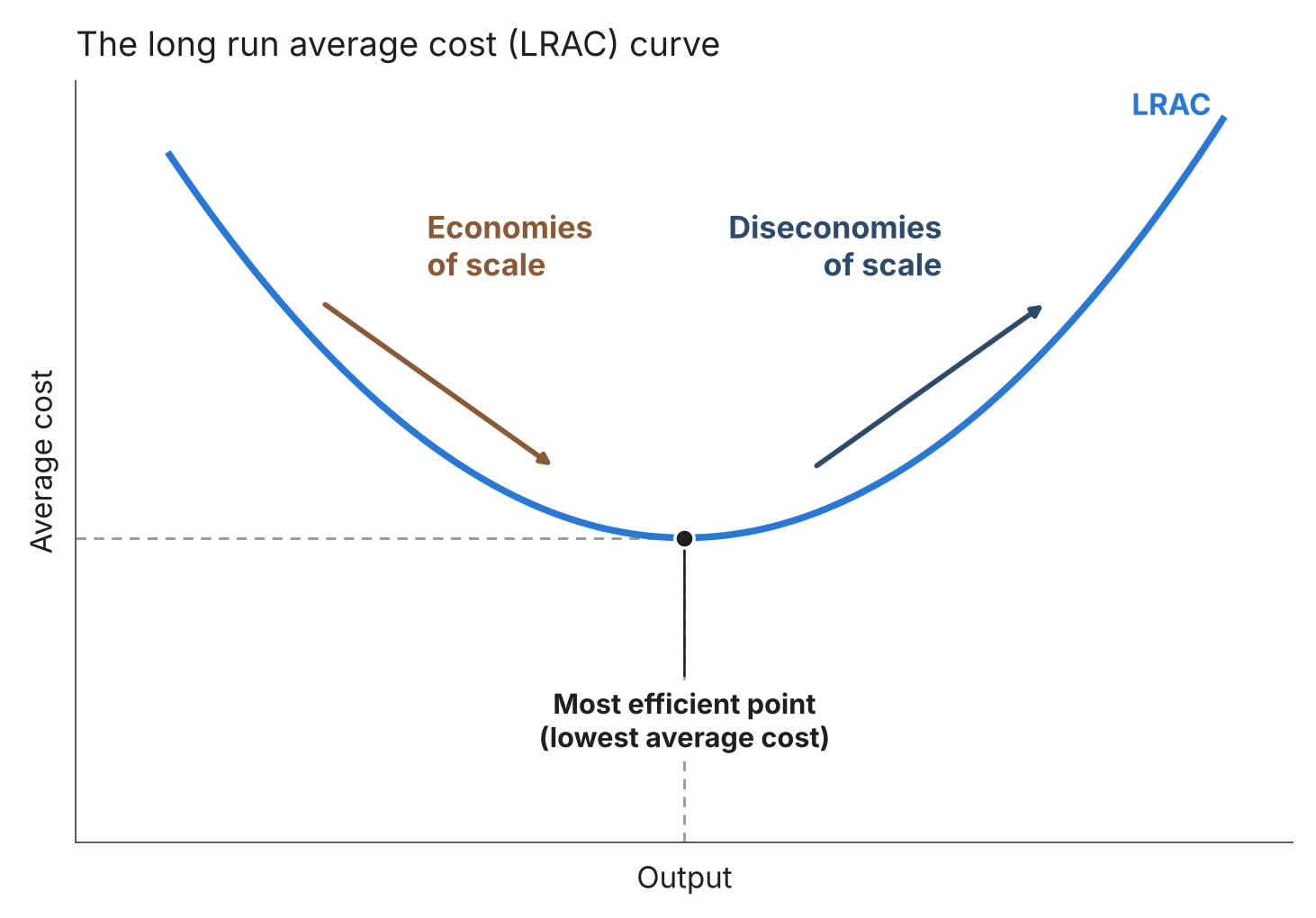
The three parts of the LRAC curve:
- Economies of scale: as output rises, the curve slopes downwards, because average costs are falling.
- The most efficient point: the lowest point on the curve, where average cost is at its minimum. At this size the firm is most efficient and avoids waste.
- Diseconomies of scale: beyond the lowest point, the curve slopes upwards, because average costs are rising.
Example: A firm’s average cost is $18 per unit when it produces 10 000 units and $11 at 30 000 units, so it is enjoying economies of scale. At 50 000 units, average cost reaches its lowest point of $8, the most efficient size. If the firm grows to 80 000 units, average cost rises to $10, as diseconomies of scale set in.

