Business Economics
1.2.5 The labour market
Business economics
Demand for labour
A labour market has buyers and sellers, just like the market for a product. Firms and public sector organisations are the buyers of labour, and the working population are the sellers. Labour’s price is called the wage rate.
Demand for labour: The quantity of workers whom producers are willing and able to employ.
Wage rate: the amount of money paid to workers for their services over a period of time (that is, the price of labour).
The labour demand curve is downward sloping. When wages rise, firms’ costs rise, so they cut production and need fewer workers. Lower wages have the opposite effect.
Factors affecting the demand for labour
Derived demand: demand that arises because there is demand for another good.
Three factors affecting the demand for labour:
- Demand for the final product (derived demand): firms only want workers because people want the goods and services those workers produce. If demand for a product rises, demand for the workers who make or sell it rises too, and if it falls, so does the demand for those workers.
- Availability of substitutes, including machines: if machines or technology can do the job more cheaply or efficiently, firms may replace workers with them, e.g. robots on a production line. As technology advances, more jobs can be done by machines.
- Productivity of the workforce: if each worker can produce more, employing workers becomes more profitable, so demand for them is likely to rise, provided the firm can sell the extra output. However, very productive workers can also mean a firm needs fewer of them to meet the same demand.
Example: Online shopping grows quickly, so the demand for delivery drivers rises. At the same time, a large warehouse installs robot pickers, so its demand for warehouse pickers falls.
Supply of labour
Supply of labour: The number of people willing and able to work.
The supply curve for labour slopes upwards. The higher the wage rate, the more worthwhile work becomes, so more people are prepared to work.
Factors affecting the supply of labour
Labour mobility: ease with which workers can move geographically and occupationally between different jobs.
Eight factors affecting the supply of labour:
- Population size: as a country’s population grows, more people are available for work.
- Migration: immigrants add to the working population, and some countries, such as those in the Middle East, rely heavily on foreign workers. When people emigrate, the supply of labour falls.
- Age distribution of population: in many developed countries, the population is ageing, so a growing share of people are over retirement age and fewer young people are joining the workforce.
- Retirement age: if the government raises the age at which people can claim a state pension, people work for longer, so the supply of labour rises. Lowering it has the opposite effect.
- School-leaving age: if young people must stay in education for longer, they start work later, so the supply of labour falls.
- Female participation: more women working, e.g. because of equal-pay laws, more service-sector jobs and more women in higher education, adds to the working population.
- Skills and qualifications: people with good skills and qualifications are more employable, so the supply of labour for skilled jobs rises.
- Ability to move geographic locations or to different types of employment: if workers can easily move to where the jobs are, or switch to a different type of job, the supply of labour in that market rises. Better transport links have made workers more geographically mobile.
Labour market diagrams
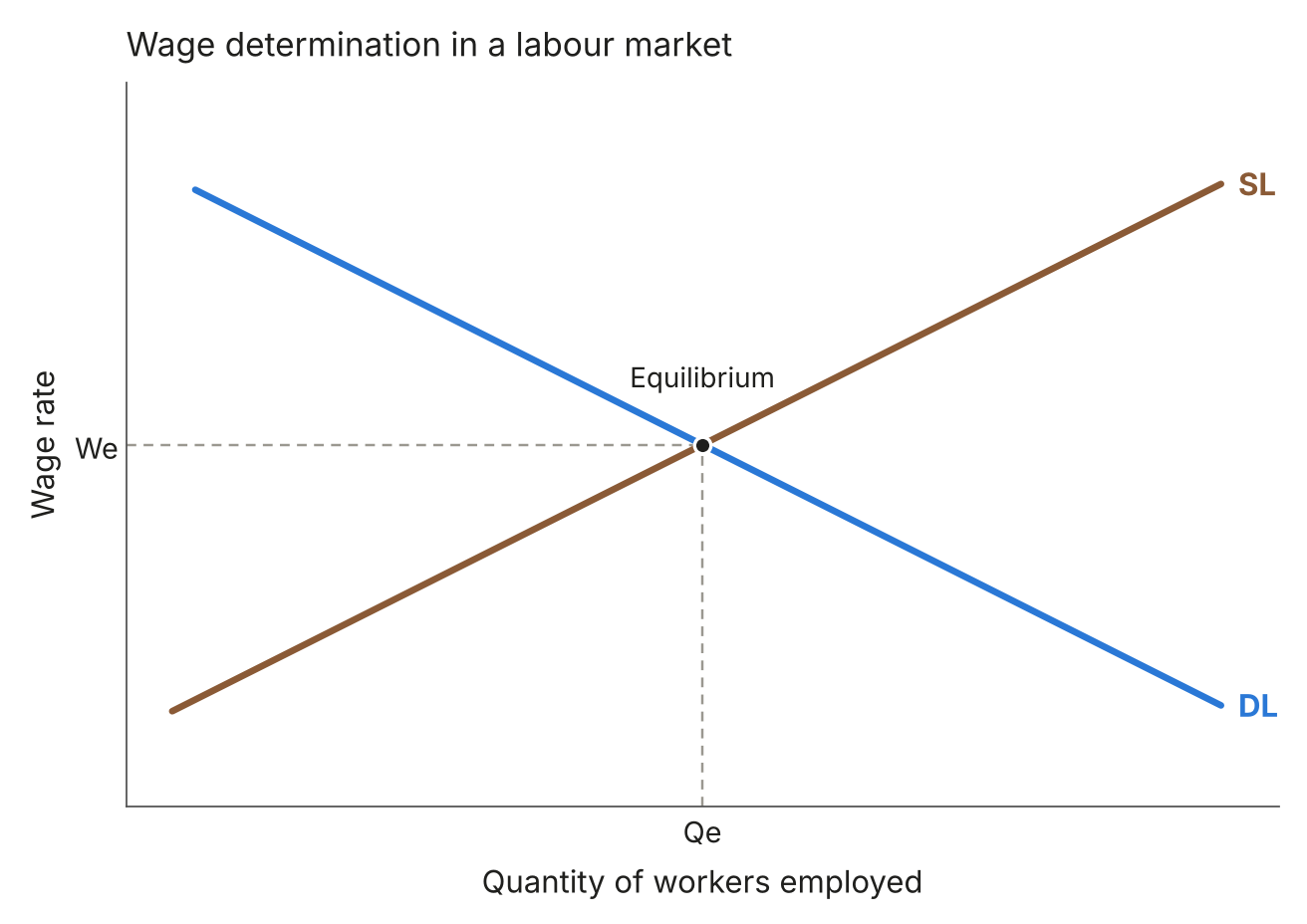
The equilibrium wage rate (We) is where the demand for labour equals the supply of labour. At this wage, the number of workers firms want to employ (Qe) equals the number of people willing to work.
If any factor other than the wage rate changes, the whole demand or supply curve shifts, changing both wages and employment.
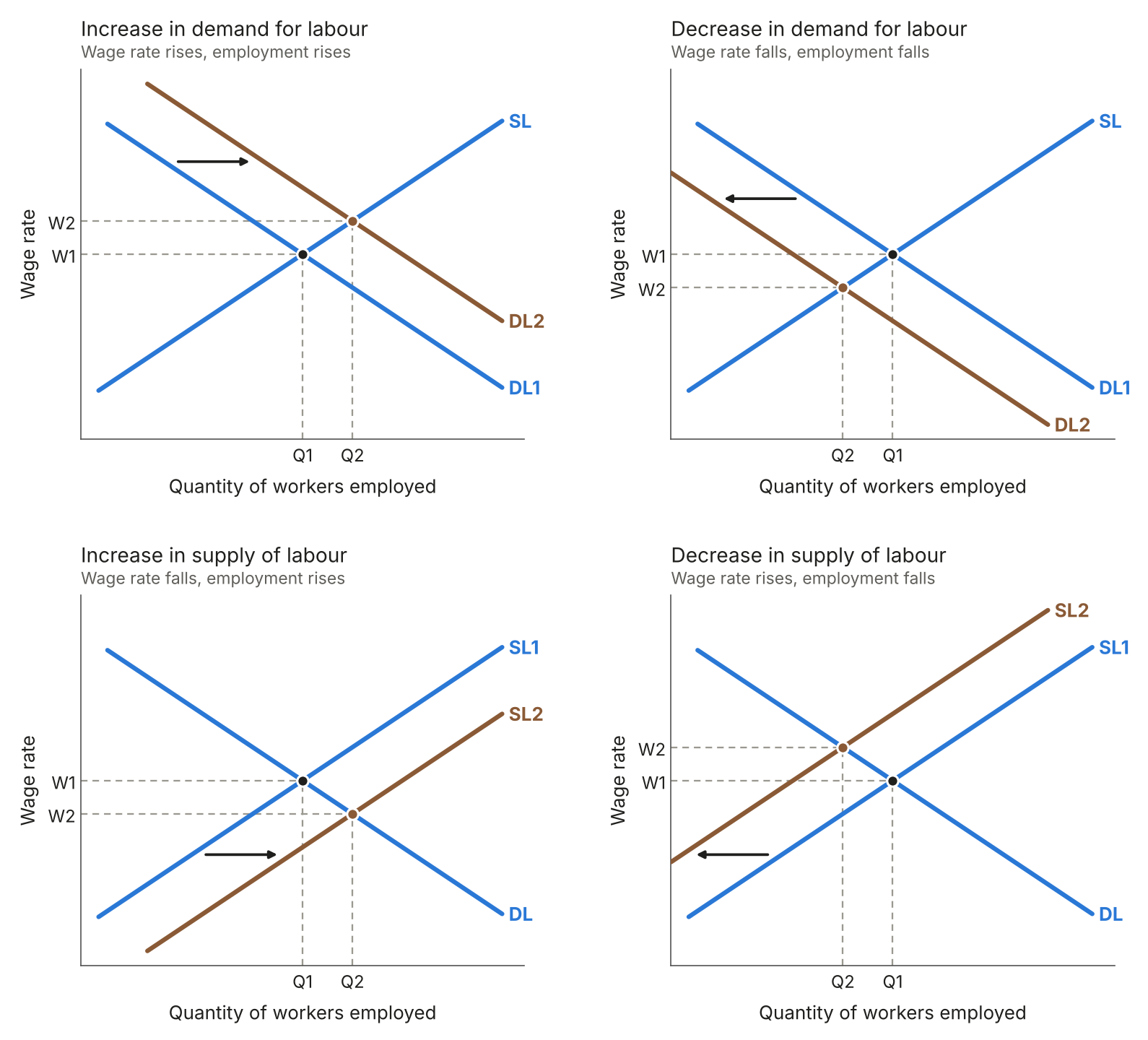
The four shifts:
- Increase in demand for labour (DL shifts right): the wage rate rises and employment rises, e.g. more demand for factory goods raises demand for factory workers.
- Decrease in demand for labour (DL shifts left): the wage rate falls and employment falls, e.g. firms replace workers with machines.
- Increase in supply of labour (SL shifts right): the wage rate falls and employment rises, e.g. more immigration or a higher retirement age.
- Decrease in supply of labour (SL shifts left): the wage rate rises and employment falls, e.g. a lower retirement age or a higher school-leaving age.
Example: A government lowers the retirement age from 67 to 65. Many older workers leave the workforce, so the labour supply curve moves left from SL1 to SL2. The equilibrium wage goes up from W1 to W2, while employment drops from Q1 to Q2.
The quantity and quality of labour
When a business chooses where to locate, the cost of labour is not the only thing that matters.
What a business needs from local labour:
- Quantity of labour: there must be enough workers near the site now, and enough in future if the business wants to expand.
- Quality of labour: workers need the right skills to keep up quality standards, and poor-quality work is costly. Where labour is cheap but mostly unskilled, a business may have to spend a lot on training.
Having enough skilled workers helps a business keep its costs down, work efficiently and make more profit.
The impact of education and training
Human capital: value of the workforce or an individual worker.
Education and training raise the quality of labour by building human capital. Employers want workers who can read, write and communicate well, and many also need specialist skills. A well-educated, well-trained workforce is more productive. In most countries, the government provides education and firms provide much of the training.
Benefits of training for a business:
- Productivity: workers gain the skills and knowledge to do their jobs well, so they produce more.
- Coping with change: workers learn about changes such as new safety rules, new machines or new ways of working.
- Flexibility: workers trained in several jobs (multi-skilled) can cover for each other.
- Motivation: workers who know how to do their job properly feel more secure and less frustrated.
However, education takes years to complete, so its effect on productivity may not be seen for a long time.
Trade unions
Trade union: An organisation for employees that aims to protect the interests of its members.
The main aims of trade unions:
- Pay and working conditions: negotiating with employers for higher wages and better conditions, e.g. better health and safety.
- Legal protection: representing members in court, e.g. in a discrimination case against an employer.
- Influencing the government: lobbying the government for laws that improve workers’ rights.
- Financial support: providing benefits such as strike pay.
The impact of trade union activity
- Higher wages: a strong union with the support of its members can put pressure on employers in pay negotiations, e.g. by threatening a strike, and push wages above what they would otherwise be.
- Better working conditions: unions push for improvements such as better health and safety, which protect workers.
- Higher productivity: better-paid workers may be more motivated, which can make employers more willing to agree to the union’s demands.
- Possible job losses: higher wages and better conditions raise firms’ costs, and firms demand fewer workers at higher wages, so some workers may lose their jobs. This may be avoided if productivity rises, if firms can pass the higher costs on in higher prices, or if they accept lower profit margins.
- Limited power: a union is only as effective as the support of its members. Workers may not think the membership fee is worth it if the union cannot win pay rises or protect jobs.
Example: A bus drivers’ union asks for a 9% pay rise and holds a two-day strike. The bus company agrees to 6%. To cover the extra cost, it raises fares by 3% and cuts two of its least-used routes, so a few drivers’ jobs are lost.

