Government and Economy
2.1.2 Supply-side policy
Government and the economy
Supply-side policy
Supply-side policy: Policies designed to increase the productive capacity of the economy by influencing aggregate supply.
Aggregate supply is the total output of goods and services a country produces over a period of time. Fiscal and monetary policy mainly work by changing demand. Supply-side policies try instead to raise how much the economy is able to produce. They are usually good for business and are mainly meant to raise economic growth, but they often take a long time to work.
The impact on productivity and total output
Productivity: rate at which goods are produced, and the amount produced in relation to the work, time and money needed to produce them.
Ways supply-side policies raise productivity:
- Education and training: a more skilled workforce produces more per worker.
- More competition: privatisation and deregulation put pressure on firms to cut costs and come up with new ideas.
- More investment: firms that buy new technology and update their factories become more efficient.
- More flexible labour markets: e.g. laws limiting trade union action made it easier for UK firms to bring in new technology and new ways of working.
When resources are used more productively, the economy’s productive potential grows, so total output can rise. This is shown by the production possibility curve (PPC) shifting outwards: the country can now produce more capital goods and more consumer goods.
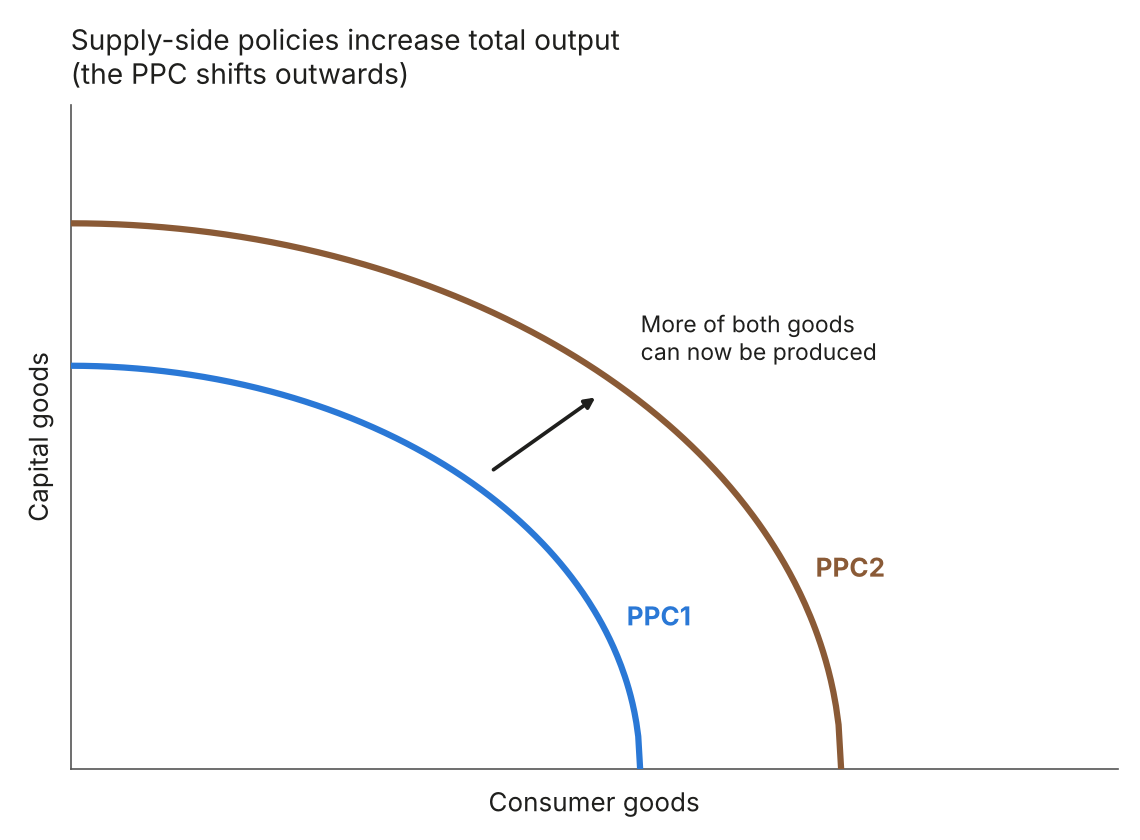
Higher output means higher national income and better living standards. More jobs are created, so unemployment falls, and with more goods and services available, there is less risk of demand-pull inflation.
Example: After a government training scheme, workers at a clothing factory learn to use new automated sewing machines. Each worker now makes 50 shirts a day instead of 40, so the factory produces more with the same number of workers.
The impact of supply-side policies on macroeconomic objectives
Privatisation
Privatisation: The act of selling a company controlled by the government to private investors.
Privatisation as a supply-side policy:
- How it works: once in the private sector, a business has to be profitable to survive. It can no longer rely on government money to cover its losses, so it has to cut costs, improve quality and give customers value for money. Some public services, such as school meals and cleaning, can also be contracted out to private firms.
- Impact on objectives: more competition and efficiency raise productivity and output, which helps economic growth. Competitive pressure should also keep prices down. Selling the business raises revenue, which the government can invest in other areas.
- Drawbacks: a state monopoly may simply become a private monopoly that exploits consumers. Some countries have seen higher prices and poor service after privatising water and energy supply.
Deregulation
Deregulation: The removal of government controls.
Deregulation as a supply-side policy:
- How it works: the government cuts “red tape”, such as too much paperwork, unnecessary licences, slow approval by committees and petty rules. Starting a business and competing then becomes simpler.
- Impact on objectives: new firms can enter markets more easily, e.g. telecommunications. More competition leads to lower prices, better quality and more choice. Firms pay fewer fees and face lower costs, so they can invest more, create jobs and increase output.
- Drawbacks: regulations exist to protect workers, consumers and the environment. Removing them can lower living standards, e.g. mines that no longer have to follow environmental controls may cause more damage. Too little regulation of banks and other financial firms is widely blamed for the 2008 financial crisis and the worldwide recession after it.
Education and training
- How it works: the government invests more in schools, colleges and universities. It can also encourage firms to train staff, e.g. by letting them offset training costs against tax or by paying part of the cost.
- Impact on objectives: better-educated, better-trained workers are more productive and easier to employ. Unemployed people can gain the skills employers are looking for, which reduces structural unemployment, and the economy’s productive potential grows.
- Drawbacks: education is very expensive and takes many years to pay off. The skills taught may not match what employers need.
Policies to boost regions with high unemployment
- How it works: supply-side policies can be targeted at regions where unemployment is much higher than elsewhere in the country. For example, the government can fund job-creation projects such as a technology park, or give firms financial incentives to train and hire long-term unemployed people in the area.
- Impact on objectives: new jobs reduce unemployment in the region, and the extra output and income there help economic growth.
- Drawbacks: the incentives cost the government money that could be spent elsewhere, and training and hiring new workers can take a long time.
Infrastructure spending
Infrastructure: The systems such as the transport network needed for the operation of an economy.
Infrastructure spending as a supply-side policy:
- How it works: the government invests in transport and communications, e.g. roads, railways, airports, energy networks and superfast broadband. Workers can travel to jobs more easily, so they are more geographically mobile, and firms can distribute goods more easily.
- Impact on objectives: in the short term, building projects create jobs and boost demand. In the long term, better infrastructure raises the economy’s productive potential and attracts investment, so output can grow without causing inflation.
- Drawbacks: projects are very expensive, so the government may have to borrow, which adds to a fiscal deficit. The money also has an opportunity cost, and output is not certain to rise. Large projects take a long time and can be hard to manage.
Lower business taxes to stimulate investment
- How it works: roughly half of private-sector investment is paid for out of profits. If profits are taxed less, firms keep more money to invest. Governments can also let firms offset the cost of new machinery and equipment against tax.
- Impact on objectives: more investment in new machinery and technology raises productivity and output, which helps economic growth and creates jobs.
- Drawbacks: the government collects less tax, which could lead to a fiscal deficit. Firms will only invest if they are confident about the future.
Lower income tax rates to encourage working
- How it works: high income tax reduces the incentive to work. Some people take more holidays, retire early or turn down overtime, and entrepreneurs avoid risky new ventures. Lower tax rates let people keep more of what they earn.
- Impact on objectives: more people choose to work instead of relying on benefits, and some work longer hours, so output rises and unemployment falls. Workers also have more to spend.
- Drawbacks: tax revenue falls, which could cause a fiscal deficit. Some of the extra income may be saved or spent on imports, and if demand grows faster than supply, prices may rise.
Example: one government’s supply-side plan
A country has slow growth and an unemployment rate of 15% in its northern region.
- Privatisation: it sells the state-owned airline to private investors for $2bn.
- Deregulation: new taxi firms no longer need a special licence to start up.
- Education and training: it funds 10 000 apprenticeships in engineering and IT.
- Regional policy: it pays firms $5 000 for each long-term unemployed worker they hire in the north.
- Infrastructure: it builds superfast broadband to every town.
- Business tax: it cuts corporation tax from 30% to 22%.
- Income tax: it cuts the basic rate of income tax from 25% to 20%.

