0264 · Topic 5
5.2 Cash flow forecast
Financial information and decisions
5.2.1 The importance of cash and cash flow forecasts
Why cash is important to a business
Cash is the money a business can spend straight away: notes and coins, plus money in the bank.
Why a business needs cash:
- To pay its bills: wages, suppliers, rent and other costs must be paid on time.
- To keep operating: without enough cash for day-to-day expenses, the business may not be able to operate.
- To keep suppliers’ trust: suppliers that are paid late may stop deliveries or want payment in advance.
- To avoid extra borrowing costs: even a short shortage of cash may mean borrowing, which adds interest.
- To survive: a business that runs out of cash and cannot pay its debts will fail, even if it is making a profit.
Example: A catering company provides $50 000 of meals to office canteens, but the offices have 60 days to pay. In the meantime, the caterer must pay its chefs and its food suppliers. It is making a profit on paper, but it may not have enough cash this month to pay its wages.
What a cash flow forecast is and why it is important
Cash flow forecast: An estimate of the timing and amount of cash inflows and outflows over a future period.
Why a cash flow forecast is important:
- Spots cash shortages in advance: the business can see which months will be short of cash and take action, e.g. cut back on spending.
- Helps arrange finance: the business knows how much it may need to borrow, and when, e.g. the size of an overdraft.
- Supports loan applications: it shows banks and investors whether the business will have enough cash to repay a loan.
- Helps planning: the business can manage its cash better, e.g. by timing large purchases for months with spare cash.
- Shows spare cash: if a large surplus is forecast, the cash could be put to better use.
- Helps decision making: it shows whether the business can afford plans such as expanding.
Main features of a cash flow forecast
- Cash inflow: cash received by the business, e.g. cash sales, payments from credit customers, loans received and money from selling non-current assets.
- Cash outflow: cash paid out by the business, e.g. wages, rent, payments to suppliers, loan repayments and buying non-current assets.
- Net cash flow: Difference (each month) between cash inflows and cash outflows.
- Opening balance: Amount of cash held at the start of the month/trading period.
- Closing balance: how much cash the business expects to have at the end of a specific period, e.g. a month. A negative closing balance warns of a cash shortage.
How the figures link together:
Net cash flow = total cash inflows – total cash outflows
Closing balance = opening balance + net cash flow
The closing balance of one month becomes the opening balance of the next month. Negative figures are shown in brackets, e.g. (500) means –$500.
Amending or completing a simple cash flow forecast
Example: a landscaping business
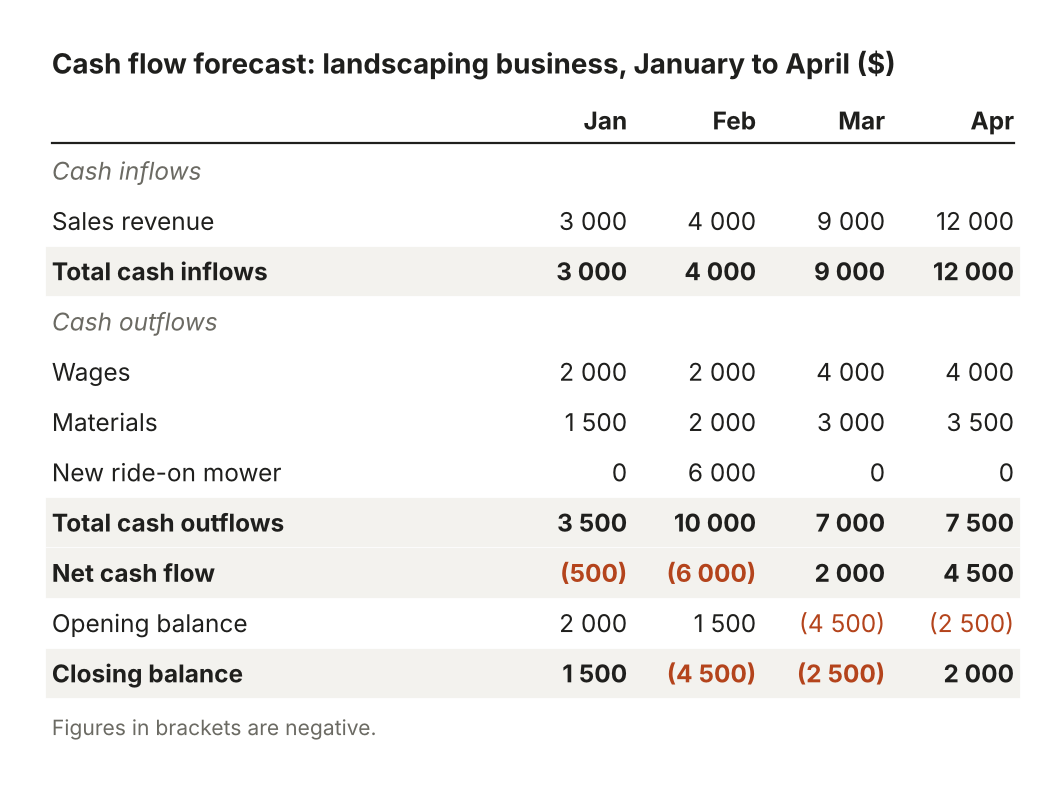
Exam questions often leave gaps in a forecast, e.g. March’s net cash flow and April’s closing balance.
Completing missing figures:
- March net cash flow: $9 000 – $7 000 = $2 000.
- April closing balance: April’s opening balance is March’s closing balance of ($2 500). So –$2 500 + $4 500 = $2 000.
Amending a forecast:
If one figure changes, every figure after it that depends on it must be worked out again. For example, if February’s sales are $1 000 higher than expected, February’s net cash flow becomes ($5 000). February’s closing balance becomes ($3 500), March’s becomes ($1 500), and April’s becomes $3 000.
Interpreting a simple cash flow forecast
What to look for:
- Negative closing balances: these are the months when the business will run out of cash and must take action.
- The biggest figures: the largest inflows and outflows.
- Patterns: seasonal changes, trends or one-off items, such as buying equipment.
- How long the problem lasts: a shortage for only a short time may be covered by an overdraft.
- Past data: whether the forecast matches earlier years, and if not, why.
Common causes of a cash flow problem:
- Customers are given too long to pay, or pay late
- Suppliers are paid too quickly, or give no trade credit
- Poor planning or unexpected costs
- Holding too much inventory
- Growing too quickly
- Low or seasonal sales
- High expenses, or large spending on assets or expansion
Example: what the landscaping forecast shows
- Problem months: the business runs out of cash in February and March.
- Cause: buying the $6 000 mower in February, when winter sales are low.
- Pattern: sales rise strongly in spring, as more customers want gardening work done.
- Overall: the problem is short-term, as the closing balance is positive again by April.
How a short-term cash flow problem may be overcome
Overdraft
Arranging with the bank to take out more money than is in the account, up to a set limit, to cover the shortage.
Advantages:
- Quick to arrange
- Interest is only paid on the amount used
Disadvantages:
- High interest rates add to costs
- The bank can ask for it to be repaid at short notice
Delaying supplier payments
Agreeing longer credit terms with suppliers, e.g. 60 days instead of 30, so cash leaves the business later.
Advantages:
- No interest to pay
- Reduces cash outflows in the months that are short of cash
Disadvantages:
- Discounts for paying early may be lost
- Suppliers may stop deliveries if payments are late
Asking customers to pay more quickly
Cutting the time credit customers have to pay, e.g. from 60 days to 30, or offering a discount for paying early.
Advantages:
- Cash comes in sooner, which increases cash inflows in the problem months
Disadvantages:
- Customers may be upset and buy from rivals instead
Delaying the purchase of non-current assets
Putting off buying equipment, vehicles or machinery until the cash position improves.
Advantages:
- Removes a large outflow from the problem months
- Cheaper than borrowing, e.g. an overdraft or a loan, to pay for the asset
Disadvantages:
- If the asset is a replacement, the business must keep using equipment that no longer works well
- Delaying expansion could mean an opportunity is missed
Example: The landscaping business delays buying the mower from February to April, when sales are high. Its closing balances become Jan $1 500, Feb $1 500, Mar $3 500 and Apr $2 000. The business never runs out of cash, so it does not need an overdraft. The drawback is that it must use its old, slower mower for two more months.

