The Global Economy
2.2.2 Methods of protection and trading blocs
The global economy
Methods of protection
Governments can protect domestic producers by making imports more expensive with tariffs, limiting the quantity of imports with quotas, or lowering domestic producers’ costs with subsidies.
Tariffs
Tariff: A tax on imported goods and services.
A tariff raises the price of imports, so consumers switch to goods made at home. Tariffs are often a percentage of the import’s price, e.g. a 10% tariff on a $200 imported bicycle adds $20 to its price.
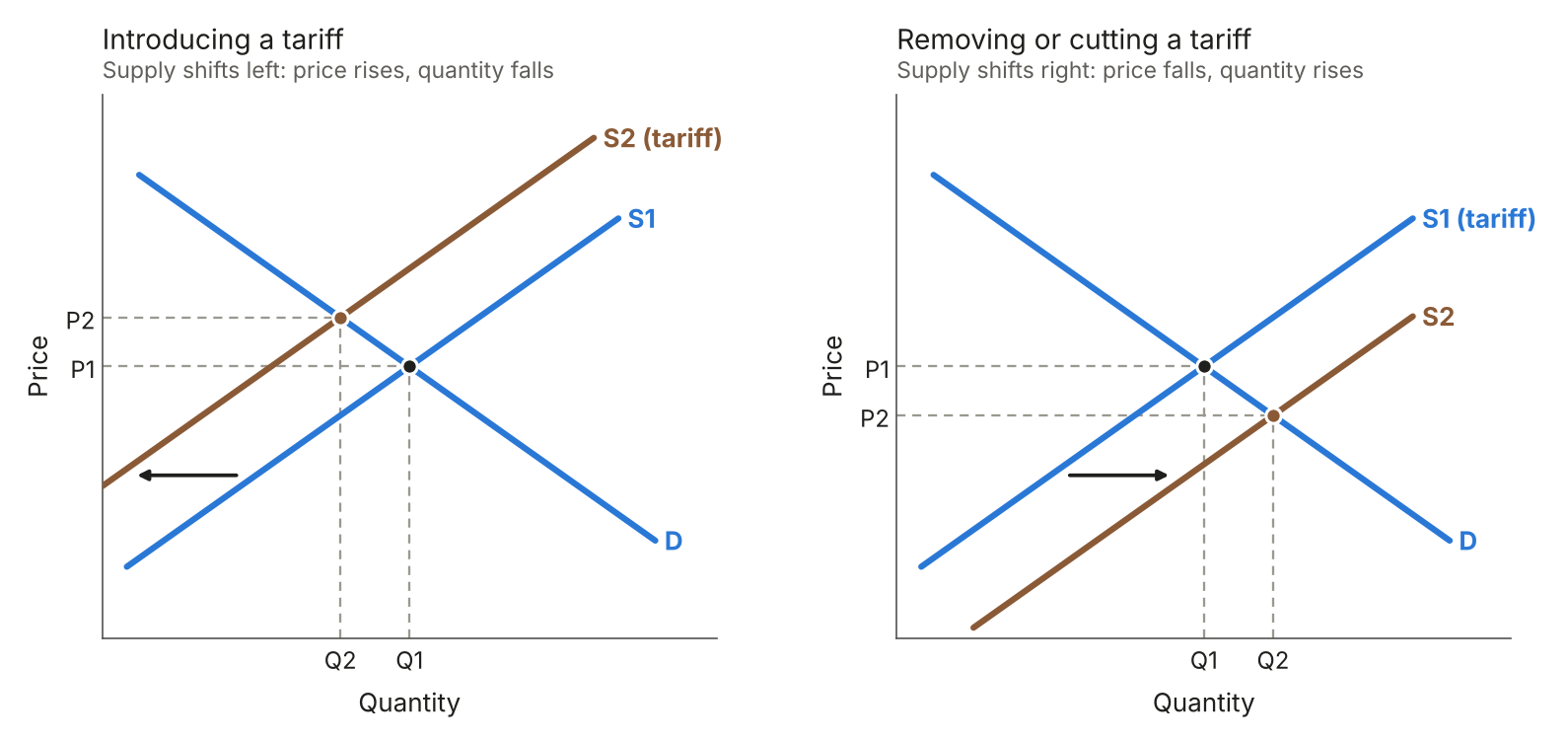
What the diagrams show:
- Introducing a tariff: the tariff adds to the cost of supplying the imported good, in the same way as an indirect tax, so supply shifts left from S1 to S2. The price rises from P1 to P2 and the quantity falls from Q1 to Q2.
- Removing or cutting a tariff: the cost of supplying the imported good falls, so supply shifts right from S1 to S2. The price falls from P1 to P2 and the quantity rises from Q1 to Q2.
Advantages of tariffs:
- Protect domestic firms and jobs: imports become dearer, so domestic firms win back sales and keep their workers.
- Raise government revenue: the money collected can pay for public services.
- Improve the current account: spending on imports falls.
Disadvantages of tariffs:
- Higher prices for consumers: imported goods cost more, and domestic firms may raise their prices too.
- Less competition: protected domestic firms have less reason to improve quality, cut costs or innovate.
- Retaliation: other countries may put tariffs on the country’s exports, which could start a trade war.
- Lost revenue: if a tariff is set too high, imports may stop completely, so the government collects nothing.
Quotas
Quota: A physical limit on the quantity of imports allowed into a country.
For example, a country might allow only 300 000 tonnes of a foreign crop in each year. Once the limit is reached, no more can be imported, so domestic producers supply the rest of the market.
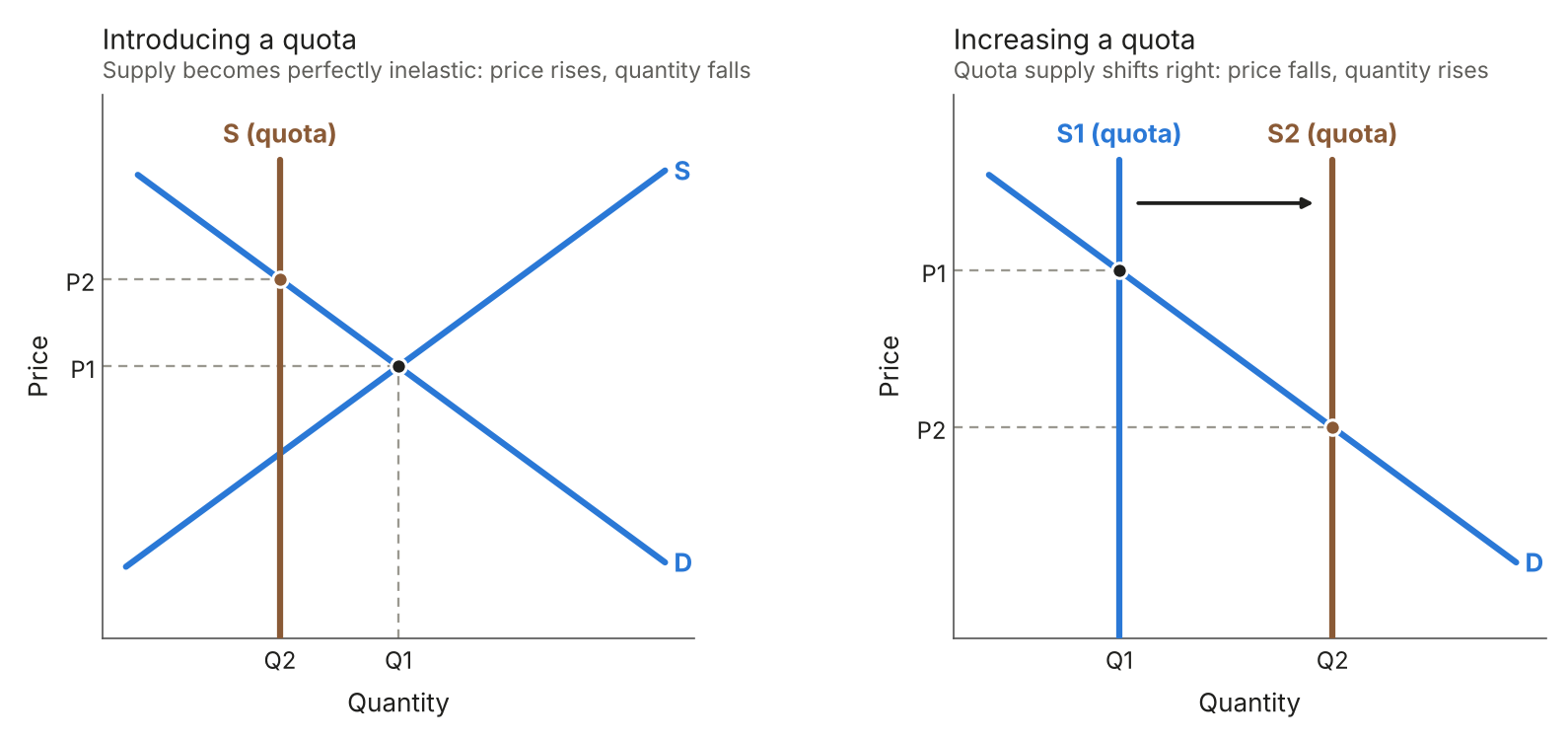
What the diagrams show:
- Introducing a quota: no more than the quota can be supplied, whatever the price, so supply becomes perfectly inelastic, a vertical line at the quota (Q2). The new equilibrium is where this line meets the demand curve, so the price rises from P1 to P2 and the quantity falls from Q1 to Q2.
- Increasing a quota: the vertical supply line shifts right, from S1 (quota) to S2 (quota). The price falls from P1 to P2 and the quantity rises from Q1 to Q2.
Advantages of quotas:
- Protect domestic producers: they face less competition, so they can gain market share and earn more revenue, which helps to protect jobs.
- A fixed limit on imports: foreign firms cannot easily get round a quota by cutting their prices.
- Prices may not rise at once: it can take time for shortages to push prices up, and domestic producers may increase their output to fill the gap in the meantime.
Disadvantages of quotas:
- Higher prices: cheap imports are in shorter supply, so prices go up.
- Less choice: consumers have fewer imported goods to choose from.
- Overprotection: domestic producers face little competition, so they may not bother to improve their efficiency.
Subsidies
Subsidy: Financial support from a government to lower the production costs of domestic firms.
Subsidies, e.g. grants or lower taxes, can be given to domestic producers that face strong competition from imports, or to exporters. They do not restrict imports directly. Instead, they make domestic goods cheaper and more competitive.
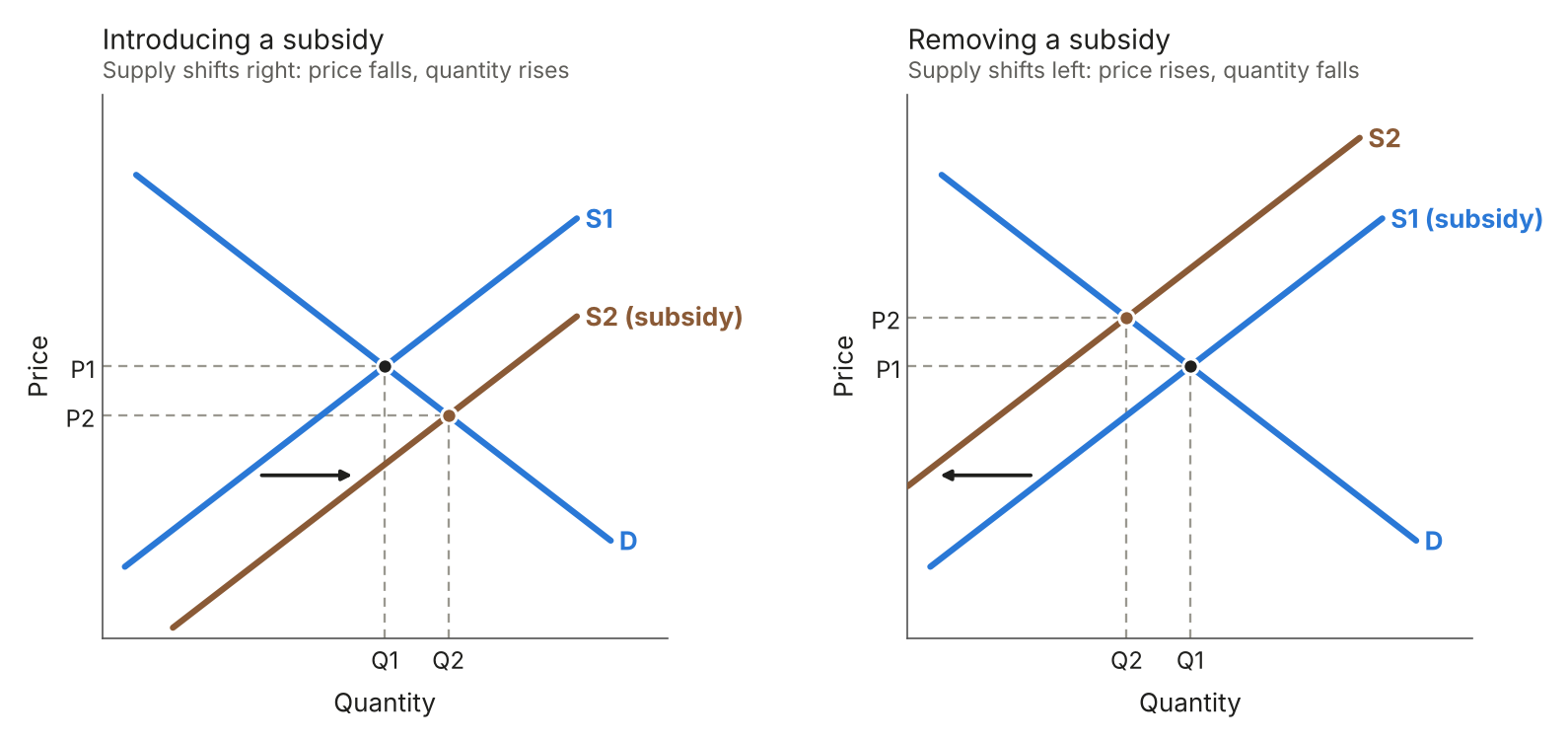
What the diagrams show:
- Introducing a subsidy: the subsidy lowers producers’ costs, so supply shifts right from S1 to S2. The price falls from P1 to P2 and the quantity rises from Q1 to Q2.
- Removing a subsidy: producers’ costs rise again, so supply shifts left from S1 to S2. The price rises from P1 to P2 and the quantity falls from Q1 to Q2.
Advantages of subsidies:
- Lower prices for consumers: producers’ costs fall and supply increases, so prices fall.
- Protect domestic jobs: domestic firms can compete with cheaper imports, so they keep their workers.
- More exports: subsidised exporters can charge lower prices abroad, which helps them break into foreign markets, encourages more firms to export and improves the current account.
Disadvantages of subsidies:
- Cost to the government: subsidies have an opportunity cost, as the money could have been spent on schools or hospitals instead.
- Inefficiency: firms may come to depend on the subsidy instead of becoming more efficient.
- Breaking trade rules: subsidies can go against what countries agreed in free trade deals, and other countries may retaliate with subsidies or trade barriers of their own.
Example: protecting domestic furniture makers
- Tariff: a 25% tariff raises the price of an imported $800 sofa to $1 000.
- Quota: only 50 000 imported sofas are allowed into the country each year.
- Subsidy: the government gives local furniture makers grants to buy new machinery, so their costs fall and they can cut their prices.
Trading blocs
Trading bloc: A group of countries in a specific region that negotiate preferential trading agreements between themselves with reduced trade barriers.
Trade between members has few or no tariffs, quotas or other barriers. Many blocs also charge the same tariff on goods coming in from countries outside the bloc. Members do not always share a border or a currency, and they can still trade with countries outside the bloc.
Impact on member countries
Advantages for members:
- Wider markets: firms can sell to every member country without trade barriers, so sales can rise.
- Economies of scale: selling to a bigger market lets firms produce more and cut their average costs.
- Lower prices and more choice: with tariffs and quotas removed, consumers pay less and can choose from goods made across the bloc.
- More FDI: foreign firms set up inside the bloc so that they can sell to the whole barrier-free market.
- Closer cooperation: members may share resources and agree common standards and laws, and a bloc can help to reduce conflict between neighbours.
Disadvantages for members:
- More competition for domestic firms: firms in other member countries may have lower costs or better technology. Domestic firms that cannot compete may lose sales, cut jobs or close.
- Cost of membership: some blocs require members to pay into a shared budget, which is paid for by taxpayers.
- Uneven gains: some members may gain far more than others.
- Relying too much on the bloc: members may trade mainly with each other, which makes them vulnerable to changes in demand within the bloc and means they may miss chances to trade with the rest of the world.
- Higher prices in some industries: inefficient producers inside the bloc are protected from cheaper rivals outside it, so consumers may pay more.
Impact on non-member countries
- Facing trade barriers: firms from outside the bloc face its common tariffs and other barriers when selling to any member, so their goods cost more there and demand for them falls.
- Finding new markets: non-members may have to sell elsewhere. In the long run this could open up new opportunities, so it is not certain that they lose out.
- Setting up inside the bloc: firms from non-member countries may build factories inside the bloc to avoid its trade barriers.
Example: a country joins a trading bloc
- Advantages for the new member: its clothing firms can now sell tariff-free to 300 million customers across the bloc, and a foreign car maker builds a factory there to supply the whole bloc.
- Disadvantages for the new member: its dairy farmers face cheaper milk from other members, and 200 farms close.
- Non-members: a non-member country’s rice exports to the new member now face the bloc’s 15% common tariff, so its sales there fall.
Examples of trading blocs
- European Union (EU): 27 European countries. Goods, services, people and capital move freely between members, and most members use the euro.
- ASEAN (Association of Southeast Asian Nations): 11 countries in Southeast Asia, including Indonesia, Malaysia, the Philippines, Singapore, Thailand and Vietnam.
- USMCA (United States–Mexico–Canada Agreement): a free trade area between the USA, Mexico and Canada, which replaced NAFTA in 2020.
- Mercosur: a South American common market whose members include Argentina, Brazil, Paraguay and Uruguay.
- African Continental Free Trade Area (AfCFTA): covers almost every country in Africa, making it the free trade area with the most member countries in the world.
The World Trade Organization (WTO)
World Trade Organization (WTO): international organisation that promotes free trade by persuading countries to abolish tariffs and other barriers.
The WTO was set up in 1995 and has 166 members, which together account for about 98% of world trade. It is the only international body that oversees the rules of world trade, and members must accept its rulings.
Actions by the WTO:
- Trade negotiations: the WTO hosts talks in which member countries agree to cut tariffs, quotas and other barriers. Agreements also cover issues such as dumping, subsidies and product standards.
- Setting and monitoring the rules: the WTO draws up the rules for international trade and checks that members follow them. Members must regularly review their trade policies and send reports to the WTO.
- Settling trade disputes: a country that believes another has broken the rules, e.g. with unfair subsidies or tariffs, can bring a complaint. Independent experts hear both sides and make a ruling, and a country that has broken the rules can be punished.
- Building membership: the WTO helps and encourages countries that are not yet members to join.
Without the WTO, there would probably be more protectionism, and trade talks would take much longer.
Example: Country A bans imports of apples from Country B, claiming they carry a plant disease. Country B says there is no scientific evidence for this and complains to the WTO. A panel of independent experts hears both sides and rules that the ban breaks WTO rules, so Country A must lift it or face penalties.
Trade patterns
Developed and developing countries tend to trade different types of goods, because the sizes of their primary, secondary and tertiary sectors are different.
Developed countries
- Exports: mainly manufactured goods and services, e.g. cars, machinery, electrical goods and financial services, because their secondary and tertiary sectors are large.
- Imports: many primary products, e.g. food, coffee and raw materials, as they have moved away from agriculture and used up many of their own raw materials.
- A wide range of exports: their economies are diversified, so they do not depend on a few products.
- Loss of manufacturing: over the last few decades, much manufacturing has moved from developed countries to lower-cost countries in Asia, e.g. China, so some developed countries now import more manufactured goods than they export.
Developing countries
- Exports: mainly primary products, also called commodities, e.g. coffee, fruit, oil and metals. They usually sell a narrower range of products.
- Imports: mainly manufactured goods, e.g. machinery and vehicles, often from developed countries.
- Commodity dependence: many developing countries rely on a few commodities for most of their export earnings. If commodity prices fall, their export revenue falls and their current account gets worse.
- A growing share of world trade: developing countries’ share of world trade has risen, helped by FDI, e.g. Chinese investment in Africa, and by lower trade barriers.
Example: Country P is a developed country. Most of its exports are cars, medicines and banking services, and it imports coffee, cotton and oil. Country Q is a developing country. Coffee and cocoa make up 70% of its exports, and it imports machinery, vehicles and medicines. When the world price of coffee falls by a third, Country Q’s export earnings drop sharply.

