The Global Economy
2.2.3 Exchange rates
The global economy
Exchange rates
Exchange rate: The price of one currency in terms of another currency.
Foreign exchange market: market where foreign currencies can be bought and sold.
Most countries have their own currency, e.g. the UK uses the pound (£), the USA uses the dollar ($) and many European countries use the euro (€). When people or firms buy from another country, they usually have to pay in that country’s currency, so they swap their own money for foreign currency. An exchange rate of £1 = $1.30 means that one pound costs 1.30 US dollars.
Converting between currencies:
- From pounds into a foreign currency: multiply the amount in pounds by the exchange rate.
- From a foreign currency into pounds: divide the amount in the foreign currency by the exchange rate.
Example: converting at £1 = €1.15
- A UK export: a UK firm sells a machine for £40 000 to a buyer in France. The price in euros is £40 000 × 1.15 = €46 000.
- A UK import: a UK shop buys €23 000 of cheese from France. The cost in pounds is €23 000 ÷ 1.15 = £20 000.
Supply and demand of currencies
Like any other price, an exchange rate is set by supply and demand.
Who demands and supplies pounds:
- Demand for pounds: comes from people and firms abroad who need pounds, e.g. to pay for UK exports or to save in UK banks.
- Supply of pounds: comes from people and firms in the UK who swap pounds for other currencies, e.g. to pay for imports or to save in foreign banks.
Factors affecting supply and demand of currencies
Currency speculators: firms, individuals or financial institutions that buy and sell currencies in the hope of making a capital gain (profit).
The three factors:
- Interest rates: if UK interest rates are above those in other countries, savers abroad want to put their money in UK banks. They must buy pounds to do this, so demand for pounds rises and the exchange rate goes up. A fall in UK interest rates has the opposite effect. If interest rates abroad rise instead, UK savers swap pounds for foreign currency to save abroad, so the supply of pounds rises and the exchange rate goes down.
- Currency speculators: currency prices can change a lot, so speculators try to buy a currency cheaply and sell it later for more. If they expect the pound to rise, they buy pounds, so demand rises and the exchange rate goes up. If they expect it to fall, they sell pounds, so supply rises and the exchange rate goes down. Their actions often make their own predictions come true.
- Imports and exports of goods and services: UK exporters expect payment in pounds, so foreign buyers of UK goods and services must buy pounds. More exports mean more demand for pounds, so the exchange rate rises. UK importers have to pay in foreign currency, so they sell pounds to buy it. More imports mean a bigger supply of pounds, so the exchange rate falls.
Exchange rate diagrams
The equilibrium exchange rate (ERe) is where the demand for a currency equals its supply. At this rate, Qe pounds are bought and sold.
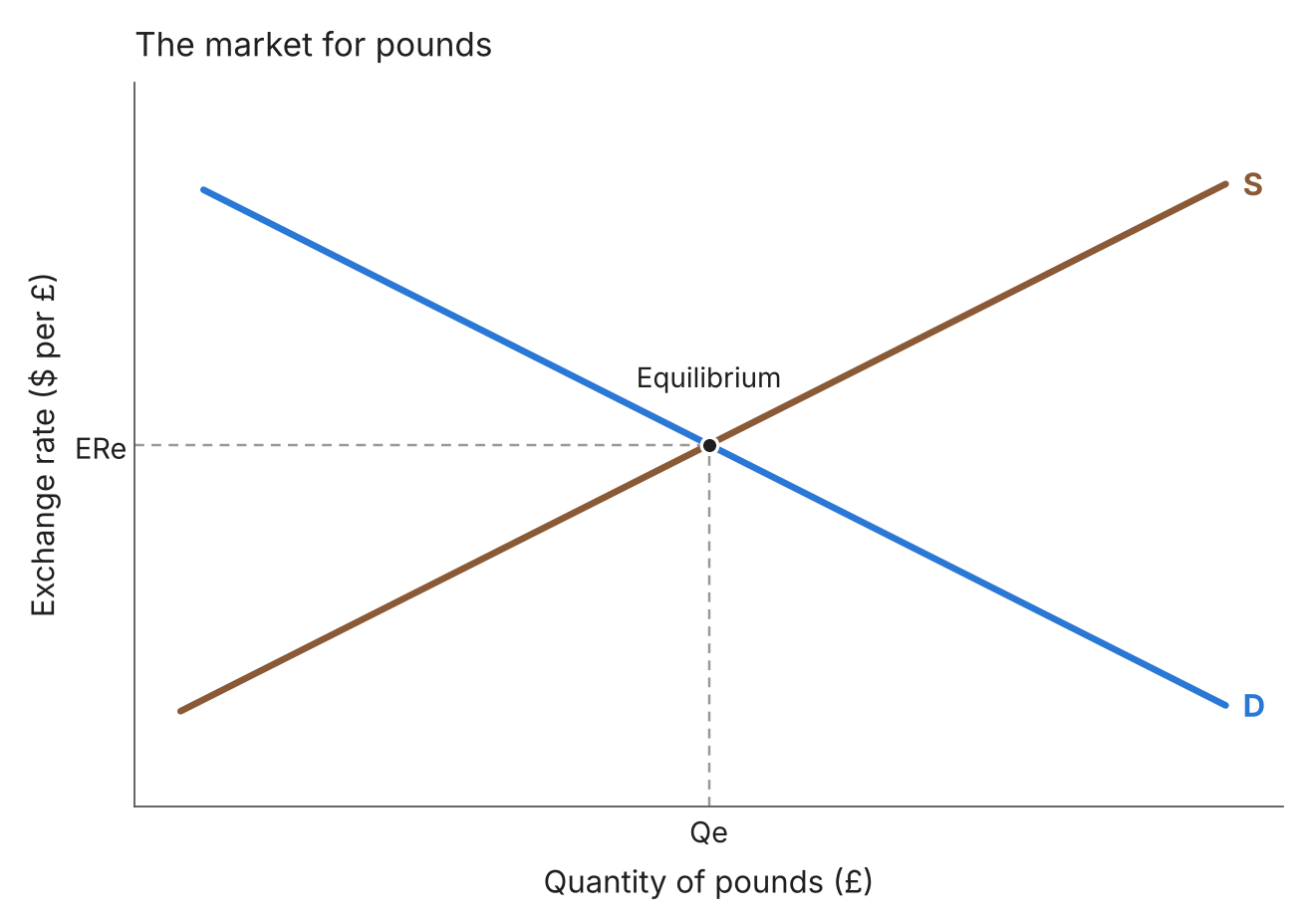
When demand or supply changes, the curve shifts and the exchange rate moves to a new equilibrium.
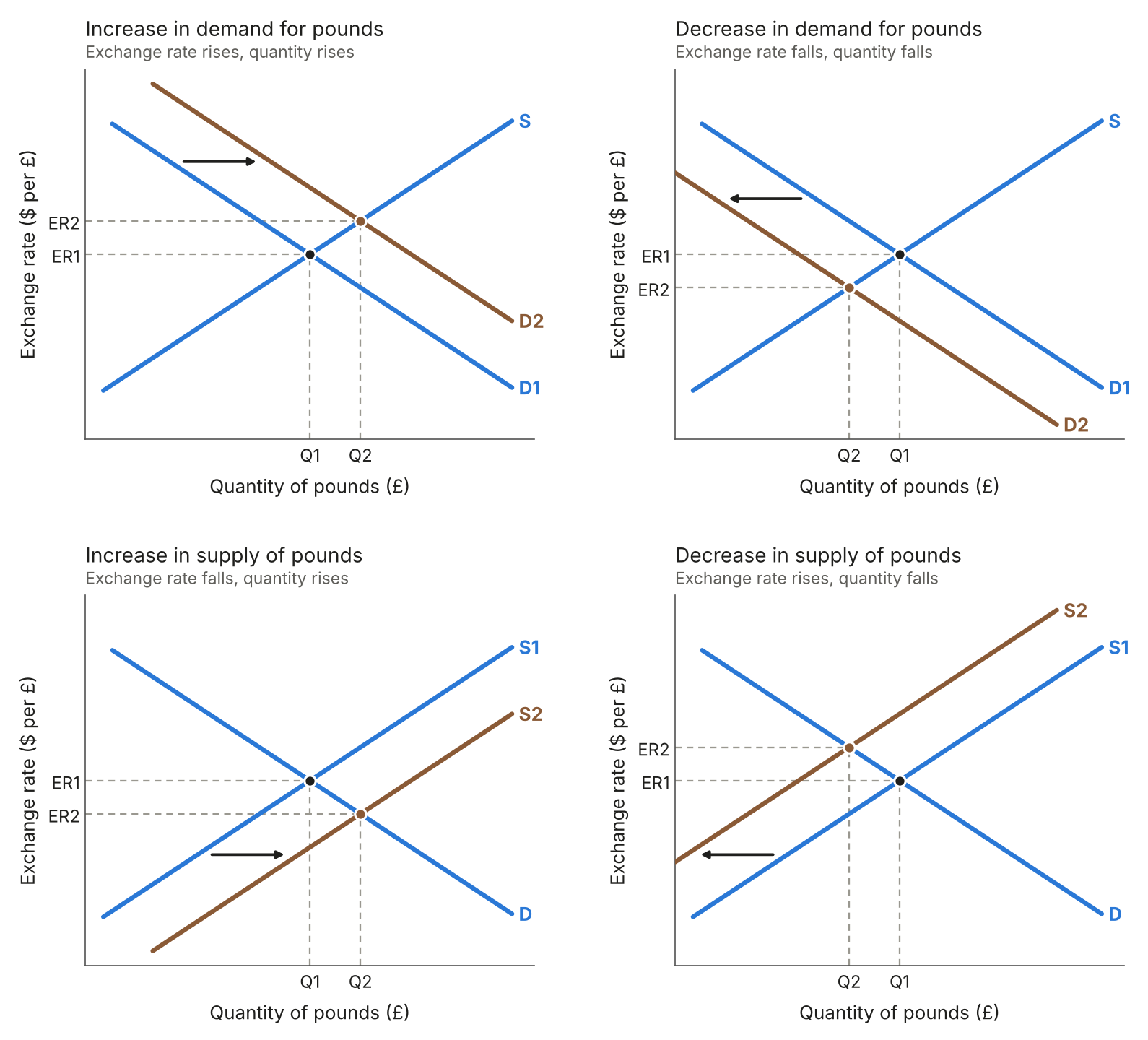
The four shifts:
- Increase in demand for pounds (D shifts right): the exchange rate rises from ER1 to ER2, e.g. because UK interest rates rise or UK exports increase.
- Decrease in demand for pounds (D shifts left): the exchange rate falls from ER1 to ER2, e.g. because UK interest rates fall or UK exports decrease.
- Increase in supply of pounds (S shifts right): the exchange rate falls from ER1 to ER2, e.g. because UK imports increase or speculators expect the pound to fall.
- Decrease in supply of pounds (S shifts left): the exchange rate rises from ER1 to ER2, e.g. because UK imports decrease.
Example: The UK’s central bank raises interest rates from 4% to 5%. Savers in other countries move money into UK banks, so the demand curve for pounds shifts right from D1 to D2. The exchange rate rises from ER1 to ER2, e.g. from £1 = $1.25 to £1 = $1.32, and more pounds are traded (Q1 to Q2).
Appreciation and revaluation
Appreciation: where the value of a currency rises due to market forces – the exchange rate increases as a result.
Revaluation: When the price of a currency in a fixed exchange rate system is officially increased against other currencies.
Both make a currency stronger, so one unit of it buys more foreign currency. The difference is the cause. An appreciation happens when supply and demand push the rate up. A revaluation happens only where the exchange rate is fixed, and the government decides to set it at a higher level.
Impact of an appreciation:
- Import and export prices: export prices rise, because foreign buyers need more of their own currency to buy the same goods. Import prices fall, because each pound buys more foreign goods.
- Demand for imports and exports: foreign buyers are likely to buy fewer exports, as they are now dearer abroad. UK buyers are likely to buy more imports, as they are now cheaper at home.
- Current account on balance of payments: with fewer exports and more imports, the current account will probably get worse, e.g. a deficit grows.
Example: the pound appreciates from £1 = $1.25 to £1 = $1.40
- A UK export worth £10 000: its price in the USA rises from £10 000 × 1.25 = $12 500 to £10 000 × 1.40 = $14 000, so US buyers may buy less.
- A US import costing $7 000: its price in the UK falls from $7 000 ÷ 1.25 = £5 600 to $7 000 ÷ 1.40 = £5 000, so UK buyers may buy more.
Depreciation and devaluation
Depreciation: where the value of a currency falls due to market forces – the exchange rate falls as a result.
Devaluation: A decrease in the exchange rate caused by government intervention.
Both make a currency weaker, so one unit of it buys less foreign currency. A depreciation is caused by supply and demand, while a devaluation happens when a government with a fixed exchange rate decides to set it at a lower level.
Impact of a depreciation:
- Import and export prices: export prices fall, because foreign buyers need less of their own currency to buy the same goods. Import prices rise, because each pound buys fewer foreign goods.
- Demand for imports and exports: foreign buyers are likely to buy more exports, as they are now cheaper abroad. UK buyers are likely to buy fewer imports, as they are now dearer at home.
- Current account on balance of payments: with more exports and fewer imports, the current account will probably improve, e.g. a deficit shrinks.
How much demand changes depends on price elasticity of demand. If a country’s imports are mainly essentials, e.g. food and fuel, demand for them is price inelastic, so higher import prices will not cut spending on them by much. A depreciation helps exports most when demand for them is price elastic, e.g. for tourism or consumer durables.
Example: the pound depreciates from £1 = $1.32 to £1 = $1.20
- A UK export worth £10 000: its price in the USA falls from £10 000 × 1.32 = $13 200 to £10 000 × 1.20 = $12 000, so US buyers may buy more.
- A US import costing $6 600: its price in the UK rises from $6 600 ÷ 1.32 = £5 000 to $6 600 ÷ 1.20 = £5 500, so UK buyers may buy less.

